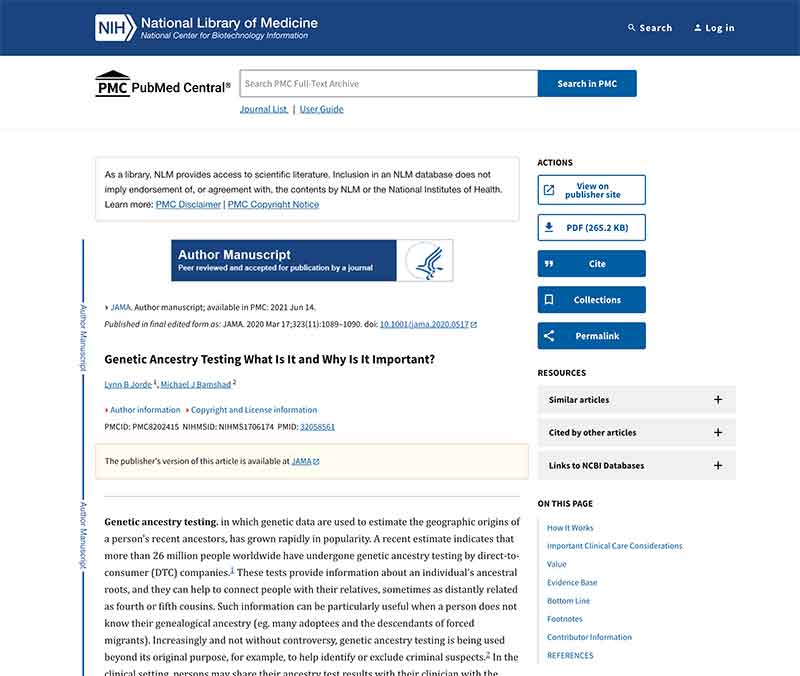
Jose Mier has asked about this in the past. DNA test kits for family history research now exist but just how do they work? Some pros and cons of the tests can be found on the National Institutes of Health website.
In the last decade, home DNA testing kits have transformed from niche scientific products into mainstream tools used for genealogy, personal health insights, and exploring one’s ancestry. Millions of people have purchased kits from companies like 23andMe, AncestryDNA, MyHeritage, and others in hopes of learning more about their origins, traits, and genetic relationships. Despite their popularity, many people remain uncertain about how the process actually works behind the scenes. While the user experience appears simple—you spit into a tube or swab your cheek and mail it in—the scientific and technological processes that unfold in the laboratory are far more intricate. Understanding how these kits work requires exploring DNA collection, extraction, genotyping, data analysis, and the interpretation methods that make results possible.
Collecting the DNA Sample: The First Step
Home testing kits begin with an easy collection process designed so that virtually anyone can participate without medical training. Most kits use one of two methods:
- Saliva Sample – The most common method, used by 23andMe and AncestryDNA. Customers spit into a small plastic tube until the sample reaches a fill line. Saliva contains epithelial cells—cells that line the mouth—each of which contains a complete copy of a person’s DNA.
- Buccal (Cheek) Swab – Used by some other companies, this involves rubbing a sterile cotton swab along the inside of the cheek. Like saliva, this collects cheek cells, which hold DNA in their cell nuclei.
Once the sample is collected, the user seals the tube containing a stabilizing solution. This solution preserves DNA by preventing bacterial growth and degradation during shipping. The sample is then mailed back to the company’s laboratory using a prepaid package included with the kit.
Arrival at the Lab and Preparing the DNA
Once the sample arrives in the lab, technicians begin the process of isolating the DNA. The sample typically undergoes several steps:
- Lysis (Breaking Open the Cells)
Technicians use detergents or enzymes to break apart the cell membranes and release their contents, including DNA. This process disrupts both the outer cell membrane and the nuclear membrane.
- Protein Removal
Proteins and other cellular debris must be filtered away. The lab may use chemical solutions, centrifugation, or silica-based columns to bind DNA while washing away everything else.
- DNA Purification
After unwanted materials are removed, the sample is purified. The resulting DNA is stable, clean, and ready for genotyping—the process of identifying specific genetic markers.
The amount of DNA in a saliva or cheek swab sample is small, but modern techniques allow labs to amplify (multiply) the DNA or work with small quantities directly, depending on the test.
Genotyping: The Heart of the Home DNA Test
When most people think of DNA analysis, they imagine full genome sequencing—reading every one of the three billion base pairs in the human genome. However, home testing kits generally do not sequence the entire genome. Instead, they use genotyping, a process that examines hundreds of thousands of specific sites across the genome called SNPs, or single nucleotide polymorphisms.
What Are SNPs?
SNPs are locations in DNA where humans commonly differ by a single letter (A, T, C, or G). These small differences account for much of the genetic variation between individuals. SNPs influence inherited traits such as eye color, height tendencies, lactose tolerance, and susceptibility to certain diseases. They also provide clues about ancestry because some SNP patterns are more common among people from certain geographic regions.
Microarray Technology
To read these SNPs, testing companies use high-density microarray chips. These chips contain microscopic probes that attach only to specific genetic sequences. When a customer’s DNA is washed over the microarray, the probes bind to matching SNP positions.
Fluorescent tags allow machines to scan the chip and determine which SNP variations are present. A single microarray can read over 600,000 SNPs at once, generating a vast amount of data.
Analyzing the Data: Comparing DNA to Global Databases
Once the raw genetic information is collected, the company’s algorithms analyze the SNPs to produce various reports. The two most common categories are ancestry and traits, although some companies also provide health-related information.
Ancestry and Ethnicity Estimates
Millions of customers’ DNA results are stored in enormous reference databases. To estimate ancestry, the company compares the user’s SNP patterns to those of people from known geographic regions. If certain DNA variations appear frequently in people from Ireland, Nigeria, Japan, or Indigenous American populations, for example, the software uses statistical modeling to determine the likelihood that the user shares ancestry with those groups.
The accuracy of ancestry estimates improves as databases expand. However, it’s important to note that the percentages are estimates, not precise measurements. Each company has its own reference populations and algorithms, so ethnicity estimates may differ between services.
Relative Matching
Another popular feature of DNA kits is the ability to identify genetic relatives. Because humans share specific proportions of DNA with biological relatives—50% with parents, 25% with half-siblings, 12.5% with cousins—testing companies can compare the shared SNPs between customers and estimate relationships.
This has led many people to discover unknown siblings, cousins, and extended family connections.
Traits and Genetic Indicators
Many SNPs are associated with traits such as:
- Eye color
- Hair texture
- Sensitivity to certain foods
- Sleep patterns
- Exercise response
These tests do not determine traits with absolute certainty but use probability based on known genetic associations.
Health-Related Genetic Information
Some companies offer limited health reports. These may include:
- Carrier status for genetic disorders
- Predispositions to conditions
However, U.S. regulations restrict what consumer DNA companies can claim without clinical testing. These results should never be treated as medical diagnoses.
Data Interpretation: Turning Genetics Into Reports
Interpreting genetic data requires sophisticated algorithms. Companies use statistical analysis, population genetics, and machine learning to translate SNP results into user-friendly reports. This includes mapping ancestry percentages, predicting traits, and generating family-tree connections.
The interpretation process is ongoing—databases grow, new genetic associations are discovered, and companies often update results automatically over time. A user may see changes in their ancestry composition years after initially submitting their sample.
Privacy and Security Considerations
Because DNA is deeply personal, privacy is a major concern for many users. Companies generally promise encrypted storage, anonymization, and optional data sharing. Users can often choose whether their DNA is shared with research partners or used for relative matching.
Some law enforcement agencies have used DNA databases to solve crimes, though typically only through services that allow open matching, such as GEDmatch. This raises ethical questions about genetic privacy that continue to evolve.
Limitations of Home DNA Testing
While powerful, home DNA kits have limitations:
- They do not sequence the full genome.
- Trait predictions are probabilistic, not definitive.
- Health results are limited and should be confirmed through medical testing.
- Ancestry estimates depend on reference databases and may shift over time.
- DNA cannot reveal cultural, linguistic, or social heritage—only genetic patterns.
Despite these limitations, the technology provides meaningful insight for many people.
Why Home DNA Tests Have Become So Popular
The rise of affordable microarray technology, combined with large genetic databases, has made DNA testing more accessible than ever. For many users, DNA kits are appealing because they offer:
- Personal identity exploration
- Genealogy tools
- Family connection discovery
- Scientific curiosity satisfaction
- Insights into health predispositions
Their ease of use and relatively low cost have made them a global phenomenon.
The Future of Home DNA Testing
As technology advances, consumer DNA testing will likely become more sophisticated. Full-genome sequencing may become inexpensive enough for widespread use, providing more detailed insights than SNP genotyping. Health reports may become more accurate, and privacy protections may evolve alongside public demand.
The field of genetics is expanding quickly, and home DNA kits serve as a bridge between advanced genetic science and everyday consumers.