Sun Valley’s Jose Mier ponders different approaches to genealogy for his readers. Today he investigates how to at least start researching African heritage.
African genealogy is a rich and complex field that connects individuals to centuries of history across the African continent and the global African diaspora. Unlike many European genealogical traditions that rely heavily on written documentation, African genealogy often blends oral history, cultural traditions, colonial records, and modern scientific tools such as DNA analysis. This layered approach reflects the realities of African history, including pre-colonial societies that preserved lineage through storytelling, the disruptions caused by the transatlantic slave trade, and the gradual expansion of written records during and after the colonial era. Today, researchers draw from a wide array of sources—including family narratives, church records, government archives, and international databases—to reconstruct family histories that were once thought lost.
One of the defining features of African genealogy is the importance of oral tradition. In many African cultures, history was preserved through generations by griots, elders, and community storytellers who memorized and passed down family lineages, migrations, and significant life events. These oral accounts often include details that written records never captured, such as clan affiliations, tribal identities, and social roles within a community. For individuals tracing their roots, especially those whose ancestors were affected by displacement or enslavement, oral history can provide essential clues that guide further research. Even in modern genealogical practice, interviewing family members remains one of the most valuable first steps in building a family tree.
The challenges of African genealogy are particularly evident when researching African American ancestry. The institution of slavery in the United States systematically erased or obscured identities, separating families and leaving limited documentation for enslaved individuals. Many enslaved people were recorded only by first names, if at all, and were often listed as property in estate inventories or bills of sale. After emancipation, formerly enslaved individuals frequently adopted new surnames, making it difficult to trace earlier generations. As a result, African American genealogy requires specialized strategies, such as examining plantation records, Freedmen’s Bureau documents, and post–Civil War census records. These sources can help bridge the gap between slavery and freedom, allowing researchers to reconstruct family connections despite fragmented records.
Despite these obstacles, the field has seen remarkable progress in recent decades. The rise of digital archives and online genealogy platforms has made many historical records more accessible than ever before. Databases such as FamilySearch and Ancestry now include collections specifically focused on African and African American records, including slave schedules, military records, and migration documents. Additionally, DNA testing has revolutionized the field by enabling individuals to identify genetic connections to specific regions or ethnic groups in Africa. While DNA results often provide broad regional insights rather than precise ancestral villages, they can still offer powerful confirmation of heritage and open new avenues for research.
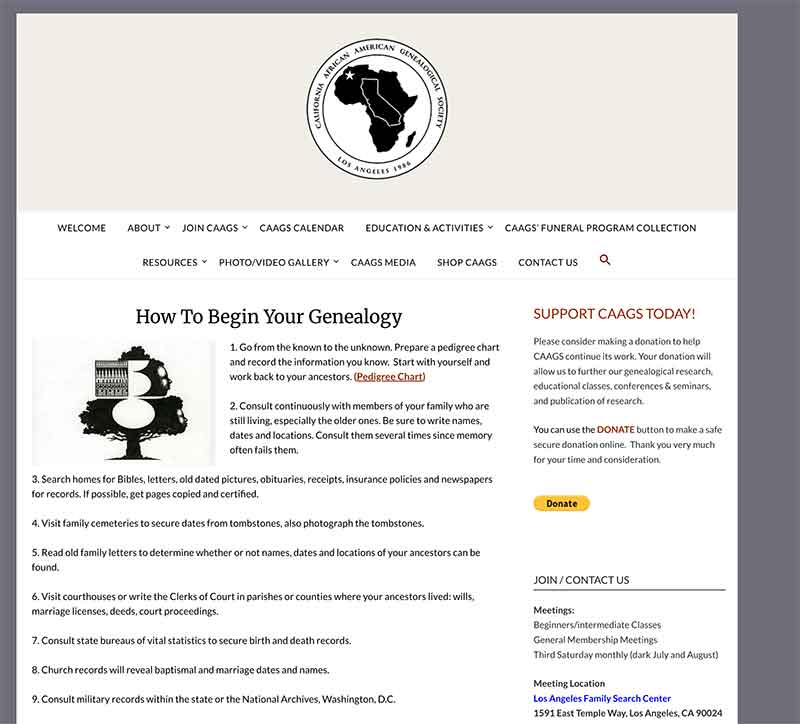
Organizations dedicated to African and African American genealogy have played a critical role in advancing research and supporting individuals on their genealogical journeys. Among the most influential is the California African American Genealogical Society (CAAGS), based in Los Angeles. Founded in the mid-1980s, CAAGS was established to bring together researchers, historians, and community members interested in preserving and documenting African American family histories. Its mission is to foster genealogical research through education, collaboration, and the publication of reliable historical work, while also encouraging the preservation of African American genealogical materials in libraries and archives.
CAAGS provides a wide range of resources and services to both beginners and experienced genealogists. The organization hosts monthly meetings, workshops, and classes designed to teach research techniques and help individuals overcome common obstacles—often referred to as “brick walls”—in their family history research. It also facilitates access to specialized collections, such as those housed at the FamilySearch Center in Los Angeles, where researchers can explore records focused on African American heritage. These collections include historical documents, family histories, and other materials that can illuminate the lives of ancestors who may not appear in more conventional records. Beyond providing access to resources, CAAGS fosters a sense of community among genealogists. Members share knowledge, collaborate on research, and support one another in uncovering their family histories. This communal approach reflects a broader trend in African genealogy, where collective memory and shared experiences often play a crucial role in reconstructing the past. The organization also emphasizes ethical research practices and encourages individuals to document and preserve their findings for future generations. Other organizations, such as the Afro-American Historical and Genealogical Society (AAHGS), further contribute to the field by promoting scholarly research, publishing journals, and maintaining networks of genealogists across the United States. These groups provide educational programs, conferences, and access to archives that support both academic researchers and everyday individuals seeking to learn more about their ancestry.
Their work underscores the importance of preserving African American history as an integral part of the broader American narrative.
Researching African genealogy often requires a multidisciplinary approach that combines historical research, anthropology, and genetics. For example, understanding migration patterns within Africa—such as movements between West and Central African regions—can help contextualize DNA results and historical records. Similarly, knowledge of colonial history can shed light on why certain records exist in European archives, such as those in the United Kingdom, France, or Portugal. These archives may contain shipping records, missionary reports, and administrative documents that provide valuable insights into African ancestors and their experiences.
In addition to traditional records, cultural practices can also serve as important genealogical clues. Naming conventions, for instance, often reflect family heritage, religious beliefs, or historical events. In some African cultures, names may indicate the day of the week a person was born, their birth order, or significant circumstances surrounding their birth. Understanding these conventions can help researchers interpret family histories and identify connections between individuals and communities.
Migration is another key factor in African genealogy. The African diaspora spans continents, with descendants of African peoples living in the Americas, the Caribbean, Europe, and beyond. Each region has its own unique historical context and record-keeping practices, which can influence the availability and type of genealogical resources. For example, Caribbean records may include plantation documents and colonial censuses, while Latin American countries may have church records that date back several centuries. Tracing ancestry across these regions often requires navigating multiple languages, legal systems, and archival traditions.
Technology continues to transform the field, making it easier to connect with distant relatives and share research findings. Online forums, social media groups, and collaborative genealogy platforms allow individuals to exchange information and build collective knowledge. DNA databases, in particular, have enabled people to discover relatives they might never have found through traditional research methods. These connections can provide new leads, confirm family stories, and deepen understanding of one’s heritage.
However, it is important to approach DNA testing with a critical perspective. While it can offer valuable insights, it also has limitations, including the potential for incomplete or evolving data. Genetic ancestry results are based on reference populations and statistical models, which may change as more data becomes available. Additionally, ethical considerations—such as privacy concerns and the interpretation of results—should be carefully considered when using DNA as a genealogical tool.
Ultimately, African genealogy is about more than tracing names and dates; it is a journey of identity, resilience, and cultural rediscovery. For many individuals, especially those whose ancestors experienced displacement or enslavement, uncovering family history can be a deeply meaningful and transformative experience. It provides a sense of connection to the past and helps individuals understand their place within a broader historical narrative.
Organizations like the California African American Genealogical Society play a vital role in this process by providing resources, education, and community support. Their work ensures that African American histories are not only preserved but also celebrated and shared with future generations. As more records become available and technology continues to advance, the field of African genealogy will undoubtedly continue to grow, offering new opportunities for individuals to explore their roots and honor their heritage.
In this way, African genealogy stands as both a scholarly pursuit and a deeply personal endeavor—one that bridges continents, generations, and cultures, and keeps the stories of the past alive for those who seek to understand them.