Jose Mier, Sun Valley, CA amateur genealogist, asks the question, “how does one do family history research in Japan?” There are many resources to help people with this including the site JapanGenealogy.com.
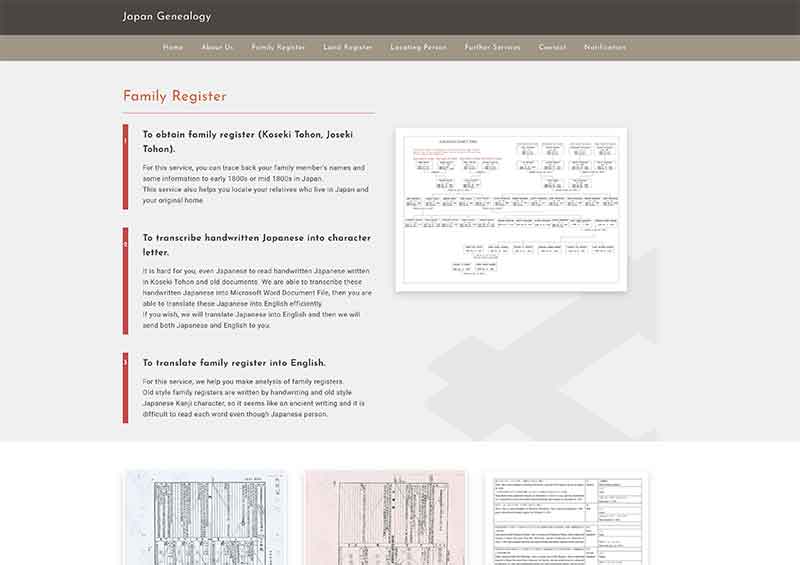
Family history research in Japan can be an immensely rewarding endeavor, offering insights into a rich and well-documented cultural past. Yet it also poses unique challenges, especially for researchers based outside Japan or those unfamiliar with the country’s record-keeping traditions, privacy laws, and historical context. Unlike many Western nations where census records, church registers, and civil registrations have long been accessible to the public, genealogical work in Japan revolves around a distinct set of documents—most notably the koseki (family registry). To trace Japanese ancestors successfully, a researcher must understand the structure of Japanese records, how to access them, and how to interpret the historical nuances they contain. With the right approach, these documents can reveal generations of family connections in extraordinary detail.
Understanding the Foundation: The Koseki System
The most important resource in Japanese genealogy is the koseki, or family registry. Established in its modern form in the late 19th century, the koseki records births, deaths, marriages, divorces, adoptions, and household relationships. Rather than tracking individuals separately, the koseki organizes information around family units. Each registry is tied to a honseki, the official domicile location that determines where corresponding documents are stored.
A koseki can reveal parents’ and children’s names, dates of major life events, maiden names, and changes in family structure over time. Older, pre-war koseki can include additional notes about occupations, household lineage, and even cause of death. Because they cover multiple generations—and because Japan has maintained a strong bureaucratic tradition—the koseki is unparalleled in depth.
However, access to koseki records is tightly controlled. Japanese privacy laws allow only direct descendants or individuals with a legally recognized interest to request copies. This means that while a grandchild can request the records of their grandparents, a more distant relative generally cannot. For researchers without direct Japanese ancestry, obtaining a koseki is typically impossible unless they are authorized by an immediate descendant. This legal structure places added importance on starting genealogical research within the family, gathering as much identifying information as possible about known Japanese ancestors.
Finding the Honseki: The Key to Access
To obtain a koseki, one must identify the ancestor’s honseki—the municipality where the family registry is kept. Without it, Japanese city offices cannot locate the record. Since Japan has thousands of municipalities and many have merged over the years, pinpointing the correct one is crucial.
If a researcher knows the town, village, or prefecture the family originated from, this provides a starting point. But sometimes the only available information is a surname and a general region, which can be challenging given the number of common Japanese surnames. Family artifacts, immigration documents, naturalization records, and oral histories often hold clues. For example, U.S. immigration and alien registration files sometimes include a Japanese hometown name. Marriage records may list a birthplace or parental information. Even small details—such as the type of dialect spoken or a family business—may offer hints about a region.
Once the honseki is found, requesting the koseki involves submitting documentation proving direct descent and filling out the appropriate forms. Municipal offices issue either full copies (koseki tohon) or partial extracts (koseki shohon), depending on the need. Because older versions of a registry are archived when a new koseki is created, researchers may request historical copies to trace earlier generations.
Other Essential Records in Japanese Genealogy
While koseki records are the backbone of Japanese family research, they are not the only documents available. Several other record types can supplement or extend genealogical findings, especially for ancestors who lived prior to the 19th century or outside the scope of the modern registration system.
- Juminhyo (Resident Records)
The juminhyo is a residence record that documents who lives at a particular address at a given time. It provides information on household members but is more limited genealogically than a koseki. Like the koseki, access is strictly limited, though direct family members may obtain historical copies in some situations. These records can confirm residence patterns and help establish a timeline for family movements.
- Temple Records: Shūmon Aratamechō
Before the introduction of the Meiji-era koseki, local Buddhist temples maintained detailed household records as part of the danka system, which tracked temple affiliates for both religious and administrative purposes. These records—called shūmon aratamechō—varied widely by region and temple but often included:
- Names of household members
- Ages
- Relationships
- Occupations
- Religious status
- Notes on births or deaths
Because these records were handwritten, often in classical Japanese or kanji styles no longer used, they can be difficult to interpret without specialized assistance. Not all temples preserved their archives, but where they survive, they can provide valuable information that predates the modern koseki system.
- Cemetery and Grave Records
Gravestones in Japan often contain a posthumous Buddhist name (kaimyō), dates of death, or family temple affiliations. Family graves typically hold multiple generations, allowing researchers to gather names and approximate relationships. Temple cemeteries may keep registries of burials, and contacting temple officials can yield additional information.
- Local Histories and Village Documents
Municipal and prefectural libraries in Japan frequently maintain detailed local histories (shi or shi-shi) that cover settlement patterns, prominent families, agricultural records, taxation lists, and folklore. Older family lines may be documented in genealogies known as kafu or keizu, especially in regions where certain clans historically held status.
- Military, School, and Employment Records
Records of military service, school admissions, or company employment—while not publicly accessible in all cases—can sometimes be located through family connections or local museums. Meiji- and Taishō-era documents occasionally survive in regional archives.
Language and Script Challenges
One obstacle for many researchers is the language barrier. Japanese genealogical documents use a variety of writing styles depending on the era:
- Modern Japanese (post–20th century) is relatively accessible to those with some language study.
- Pre-World War II documents often use older kanji forms and cursive scripts.
- Temple records and Edo-period documents may be written in kuzushiji, a flowing cursive script that requires specialized training to decipher.
Fortunately, modern tools and online resources have made kuzushiji more accessible, and professional genealogists in Japan can assist. Even without reading Japanese, researchers can often identify key dates, names, and family relationships with expert help.
Historical Context: Why It Matters
Understanding Japanese social history aids greatly in interpreting records. The structure of Japanese households, naming practices, and adoption customs all affect genealogy.
Household Structure
Traditional Japanese households (ie) were usually patrilineal, prioritizing continuity of the family line. The eldest son often inherited the home and responsibilities, while younger children might marry into other families, be adopted, or move away.
Adoption
Adoption was extremely common—particularly adult male adoption—to secure heirs, merge businesses, or preserve family lineage. An adopted son might take on the family surname, and koseki entries typically note adoption status. This can surprise modern researchers unfamiliar with the practice.
Naming Conventions
Given names may change over a person’s lifetime, especially upon marriage, adoption, or ordination at a temple. Women often appear under maiden names in certain records, while married names may appear elsewhere. Older documents may use archaic characters or different writing systems.
Migration Patterns
Internal migration within Japan became more common in the Meiji period due to urbanization. Rural ancestors may appear in one koseki while descendants moved to another prefecture, and tracking these movements requires careful attention.
Research from Abroad: Practical Challenges
For researchers living outside Japan, the primary obstacles include:
- Restricted access to records
- Language differences
- Lack of digitized sources
- Complex municipal processes
- Difficulty identifying the honseki
Unlike genealogy in the U.S. or Europe, where large online databases exist, Japanese records are not extensively digitized for public use. The FamilySearch Library in Salt Lake City has some microfilmed Japanese records—mostly for Okinawa and Hokkaido—but coverage is limited. Researchers often rely on:
- Japanese consulates (which can provide general guidance on koseki but cannot issue records)
- Professional genealogists in Japan
- Local historical societies
- Family papers, photographs, or oral histories
Building as much information as possible from family sources is essential before attempting to contact Japanese municipal offices.
Working with Professional Researchers
Because navigating the koseki system and temple archives can be complex, many genealogists hire Japanese researchers. A qualified genealogist can:
- Locate the correct municipal office
- Submit record requests
- Translate documents
- Conduct temple or cemetery visits
- Interpret historical script
- Create family charts in Western and Japanese formats
While hiring a professional can be an investment, it often results in breakthroughs impossible to achieve otherwise.
Preserving and Sharing Family History
Once records are obtained, preserving them is important. This may involve:
- Digitizing koseki copies
- Translating documents into English
- Constructing family trees and charts
- Recording interviews with older relatives
- Creating summaries of geographic and cultural context
Sharing the information with relatives helps ensure that the history is carried forward. Many Japanese American families use genealogical findings to reconnect with distant cousins, visit ancestral towns, or participate in heritage tours.
The Reward of Japanese Family Research
Despite the challenges, researching Japanese ancestry can be deeply meaningful. The koseki system offers a level of detail unmatched in many countries, often documenting three or more generations within a single record. Temple registries can reveal connections stretching back into the Edo period. Local histories can paint vivid pictures of the villages where ancestors lived, worked, and raised their families.
For descendants of Japanese immigrants—many of whom left Japan in the late 19th or early 20th centuries—genealogical research becomes a way to reclaim lost family connections disrupted by distance, cultural shifts, and historical events such as World War II.
In the end, family history research in Japan requires persistence, cultural sensitivity, and an understanding of Japan’s complex record-keeping traditions. But the reward—reconstructing a family lineage across oceans and centuries—is profound. With determination, the support of experts, and a thoughtful approach to Japan’s unique archival system, researchers can uncover rich, detailed stories that illuminate their ancestors’ lives and preserve them for future generations.