Jose Mier has spent plenty of time chasing names through census schedules, immigration records and parish registers, but I have learned that sometimes the best clue to a family is not a birth or death record at all. A property transaction can put an ancestor in a very specific place at a very specific time, and it can reveal relationships that are missing from other records. For my latest genealogy project, I have been looking more closely at land deeds, homestead records and other property documents.
Why Land Records Belong in a Family History File
When I think about genealogy, I usually think about people first. Land records make me think about place. A deed can tell me where an ancestor lived, what property he or she owned, who sold it, who bought it and sometimes who stood nearby as a witness. Those details can turn a vague family story into a timeline.
The National Archives guide to land records explains that land entry case files can contain information about an ancestor’s age, birthplace, citizenship, military service, literacy and economic circumstances, as well as information about family members. The Archives says it holds more than ten million individual land transactions involving the transfer of public land to private ownership.
Deeds Can Reveal Relationships
One of the reasons I find deeds fascinating is that they can connect people who are not obviously connected in a census. Suppose I find that a man sold a piece of property to another man who shares his surname. That alone proves nothing. But suppose a later deed identifies the second man as a son, brother or heir. Suddenly I have a new relationship to investigate.
Wives can also appear in property records, particularly when local law required a spouse to release an interest in property. A widow selling land may identify herself as the widow of a deceased owner. An estate transaction may name several heirs. A power of attorney can reveal that a relative was living somewhere else. In other words, the legal language surrounding a property transaction can preserve family connections that were never recorded in a family Bible.
Following a Family From One Address to Another
Land records are especially useful when an ancestor moved. I might find a purchase in one county, a sale a few years later and another purchase somewhere else. That gives me a migration trail without relying entirely on an index that happens to contain the ancestor’s name.
This is particularly helpful when I am dealing with a common name. There may be several Jose Miers, for example, but two men with the same name are less likely to have exactly the same sequence of property transactions, associates and locations. I can compare the names of spouses, neighbors, witnesses and other parties to determine whether I am following the same person.
Homestead Records Add Another Layer
For families who moved westward during the nineteenth century, federal land records can be especially rewarding. The Homestead Act of 1862 opened a path for settlers to claim public land under specified conditions. The resulting records may contain much more than a simple statement that someone owned acreage.
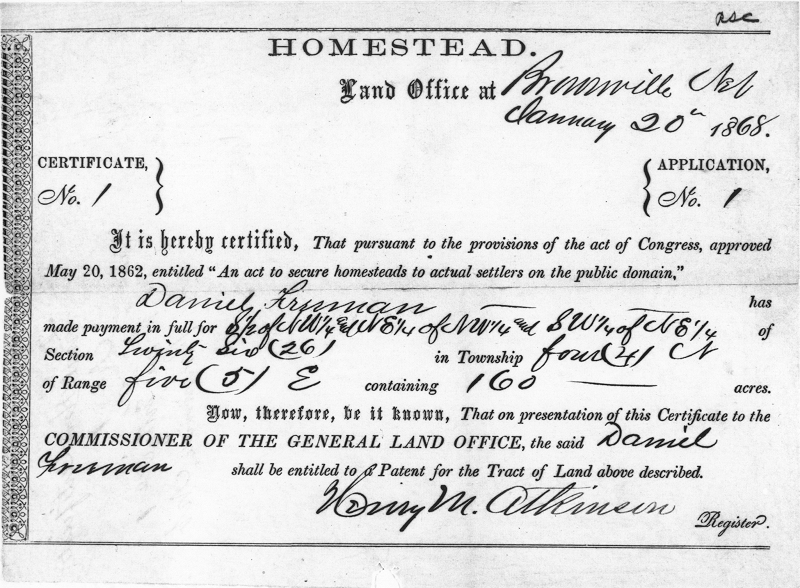
The sample document shown above is a homestead certificate associated with Daniel Freeman and dated 1868. Documents like this help me remember that genealogy is not just about collecting names. They are evidence of real decisions: where a person settled, how much land was involved and how that person interacted with the government and the surrounding community.
How I Would Start a Land-Record Search
I would not begin by searching every deed book in existence. First, I would establish the ancestor’s approximate location and time period using records I already trust. Once I know the county or land district, I can determine which office or archive would have handled property transactions.
Next, I would search both the grantor and grantee sides of an index. Grantors are people transferring property; grantees are people receiving it. A person may appear under both categories over the course of a lifetime. I would also pay attention to spelling variations, initials, middle names and neighboring property owners.
Once I locate a promising entry, I want the original document or a good image of it whenever possible. An index may say only that John Mier sold land to William Smith. The deed itself could contain a wife’s name, a residence, a description of the property, witnesses and other clues.
Maps Can Make the Story Come Alive
I also like pairing land records with historical maps. A legal description can look almost meaningless when I first read it, but an old plat map or county map may show roads, waterways, churches, schools and neighboring farms. That can help me understand why a family lived where it did.
There is also a travel opportunity here. If I discover that an ancestor owned property in a particular county, visiting the area can turn an abstract genealogy project into something tangible. I can see the landscape, visit a courthouse or local historical society and sometimes walk roads that existed when my ancestor lived there. I have already learned from researching my own name that genealogy becomes much more interesting when places are part of the story.
A Useful Video for Beginning Researchers
For anyone who has never worked with property records, this video provides a practical introduction to using deeds and land records in family history research:
My Takeaway From Land-Record Research
For me, the biggest lesson is that genealogy works best when I stop expecting one record to answer every question. A census may give me a household. A passenger list may suggest an immigration date. A church register may provide a baptism. A deed can then place that person on a particular piece of land and connect him or her with other people in the community.
That combination is what makes family history research so satisfying. Land records may look dry at first glance, filled with legal descriptions and unfamiliar terminology, but behind those descriptions are homes, farms, businesses, moves and family decisions. When I am trying to distinguish one Jose Mier from another, or simply understand where an ancestor spent an important part of life, a deed can sometimes provide exactly the clue I need.