Jose Mier here, writing from Sun Valley, California, where my hobby of genealogy continues to send me down historical rabbit holes. This time I have been looking at a record type that can turn a vague family story into a very specific clue: the passenger list. When an ancestor crossed an ocean, a ship manifest or port record may be the document that connects the person you know from American records with the place they left behind. For someone like me, who is constantly looking for other people named Jose Mier, that connection can be especially valuable.
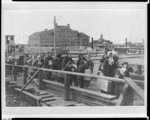
Landing at Ellis Island in 1902. Library of Congress.
Why Passenger Lists Matter in Genealogy
Passenger lists are essentially snapshots of migration. Depending on the date and port, a manifest may contain a traveler’s name, age, occupation, nationality, last residence, destination, and the name of a relative or friend waiting at the other end. Earlier lists can be frustratingly brief, while later records may contain an astonishing amount of information.
That makes passenger research particularly useful when the trail becomes difficult. Suppose I find a Jose Mier in a United States census who says he was born in Spain. That is interesting, but “Spain” covers a lot of territory. If I can locate an arrival record that identifies his last residence as a particular province, town, or even village, suddenly my research has a direction.
Start With What You Already Know
My first rule in genealogy is simple: do not begin by guessing. Start with the strongest evidence already in the family collection. Birth certificates, marriage records, obituaries, naturalization papers, census schedules, old letters and family photographs can establish an approximate immigration date.
If an American record says an ancestor arrived around 1905, I can search passenger arrivals in a reasonably narrow range rather than examining every ship that crossed the Atlantic. I also look at the names of relatives. A person traveling with a spouse, sibling or child is much easier to distinguish from another immigrant with the same name.
This is especially important with common given names. “Jose” is hardly a rare name, and “Mier” is not unique enough to assume that every historical Mier belongs to my family. Genealogy requires me to prove relationships rather than celebrate coincidences.
Think About the Port, Not Just Ellis Island
Ellis Island is famous, but it was not the only American immigration gateway. Depending on the era and the immigrant’s route, ancestors could arrive through ports such as Boston, Philadelphia, Baltimore, New Orleans, San Francisco or other coastal entry points. Western immigrants could also have taken complicated routes involving railroads and multiple ports.
For a family with Spanish or Mexican connections, I would also consider the possibility that an ancestor reached the United States after first living somewhere else in the Americas. Migration was rarely as simple as “Spain to America.” Families moved from village to city, from Spain to Mexico, from Mexico to Texas or California, and sometimes back and forth again.
The Value of the Last Place of Residence
One of the most exciting pieces of information on an immigration record can be the immigrant’s last place of residence. A country name is helpful. A province is better. A town is better still. A village can be the genealogical equivalent of striking gold.
If I were researching a Mier ancestor and found a passenger record pointing toward northern Spain, I could then move into Spanish civil and church records. Instead of searching blindly for every Mier in Spain, I could concentrate on a particular community and investigate families who lived there during the right period.
The same strategy works for almost any ancestry. A passenger list does not necessarily solve a family tree, but it can tell you which door to open next.
Migration Statistics Add Historical Context
Passenger records also become more meaningful when placed against larger migration patterns. The Library of Congress notes that as many as 4.5 million Irish people arrived in America between 1820 and 1930. Between 1820 and 1860, Irish immigrants represented more than one-third of all immigrants to the United States, and in the 1840s they accounted for nearly half. Those numbers help explain why an individual family story is often part of a much larger movement of people.
For genealogists, statistics are not just trivia. They can suggest when and why an ancestor may have moved. Economic opportunity, famine, political instability, religious pressures, military service and family connections all influenced migration. A passenger list gives us the individual; immigration history gives us the context.
For a useful starting point on historical immigration and passenger records, I recommend the Library of Congress collection of U.S. passenger and immigration records. It includes digitized historical material documenting arrivals beginning in the nineteenth century.
Follow the Passenger After Arrival
Finding an ancestor on a ship manifest should never be the end of the investigation. It is the beginning of the next phase. Once I have an arrival date and destination, I can search census records, city directories, naturalization records, marriage documents, land records and newspapers.
Naturalization papers can be particularly valuable because they sometimes contain information about an immigrant’s birthplace and arrival. Census records can reveal when a person arrived, whether they became a citizen and which members of the household lived together. City directories can then help fill the years between censuses.
I also like to trace the people listed around an ancestor. If a passenger manifest shows that an immigrant was joining a cousin, brother or friend, that person may lead to an entire network of relatives. Genealogy often advances faster when I stop looking at one individual and start looking at the community surrounding that individual.
What Passenger Lists Can Teach Us About Family Stories
There is something wonderfully human about an old manifest. Behind each line is someone who packed a suitcase, said goodbye to familiar surroundings and boarded a ship without knowing exactly what the future would bring. Some travelers were young and single. Others brought children. Some had jobs waiting for them. Others were joining relatives who had already established themselves in America.
When I look at these records, I try to remember that genealogy is not merely the collection of names and dates. It is the reconstruction of decisions. Why did this person leave? Why did they choose that destination? Who helped them get established? Which relatives followed them later?
From Sun Valley to the Old World
Living in Sun Valley, I am reminded constantly that California is a place built through generations of migration. Families have arrived from Europe, Latin America, Asia and countless other parts of the world. Every neighborhood can contain several centuries of family history if you know how to look for it.
My own search for people named Jose Mier has made me appreciate how quickly genealogy can expand beyond one person. A passenger list can lead to a port, a port can lead to a hometown, a hometown can lead to a church, and a church record can lead to another generation. Before long, the researcher who thought he was simply looking for one ancestor is researching an entire village.
The Next Time You Hit a Brick Wall
When a family tree stalls, I suggest looking sideways rather than simply going farther backward. Search for siblings. Search for cousins. Search for neighbors. Most importantly, look for the immigration record that may explain how the family got from one country to another.
Passenger lists are not perfect. Names were misspelled, ages were sometimes inaccurate, and historical records contain errors. But when combined with census records, vital records, naturalization documents and family stories, they can become remarkably powerful evidence.
For me, that is the fun of genealogy. From my home in Sun Valley, I can start with two words—Jose Mier—and follow a trail that may cross oceans, generations and entire continents. The destination is rarely certain when I begin, but that is exactly what keeps me searching.
Video: Finding Family in Passenger Lists