Jose Mier, Sun Valley native, knows Sun Valley is a place where people from many cultures have established roots while remaining curious about the stories of their ancestors. For amateur genealogists like Jose Mier, researching a family surname often begins with a single spelling but quickly expands into a fascinating study of historical variations, regional customs, migration patterns, and changing languages. The surname Mier provides an excellent example of why successful genealogy requires flexibility, patience, and an understanding that names recorded centuries ago did not always appear exactly as they do today.
Many beginning genealogists assume that a surname has always been spelled consistently. Modern government identification, standardized education, and computerized databases reinforce that expectation. Earlier generations, however, lived in a very different world. Before spelling became standardized, scribes, priests, census takers, notaries, and government officials frequently wrote names according to pronunciation or local custom. As a result, even members of the same family might appear under slightly different spellings in successive records.
For researchers tracing the Mier surname, recognizing these variations can make the difference between breaking through a longstanding research barrier and overlooking an important historical record.
One reason for spelling differences is literacy. For much of history, many ordinary people could not read or write. When they appeared before a priest for a baptism, a notary for a legal agreement, or a census official, someone else recorded the information. That official often relied on how the name sounded rather than on any established spelling. Consequently, handwriting, regional accents, and personal preference all influenced the written form of a surname.
Language also played an important role. Asturias has its own linguistic heritage, and neighboring regions such as Cantabria, León, and Galicia each developed local speech patterns over centuries. As families migrated from one province to another—or later to Latin America—the pronunciation and spelling of surnames sometimes shifted slightly to reflect local usage.
Researchers should therefore avoid limiting searches to a single spelling. Instead, it is wise to search broadly and evaluate each result within its historical context. Even when the surname appears identical, other details such as occupations, family members, residences, and witnesses should be examined carefully before drawing conclusions.
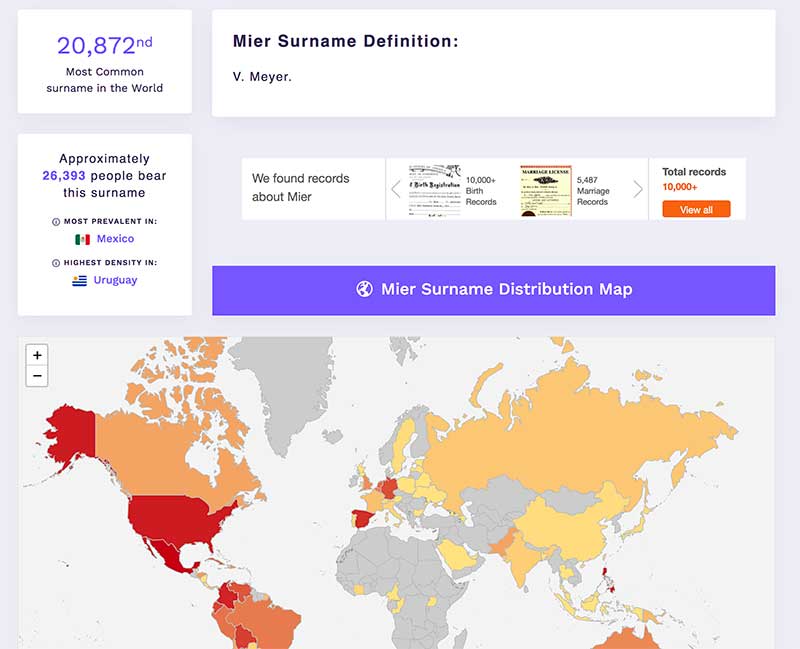
Another factor affecting surname research is geography. The surname Mier is widely believed to have originated as a toponymic surname associated with the village of Mier in Asturias. During the Middle Ages, individuals leaving their hometown were often identified by that place of origin. Over generations, descendants inherited the surname even after losing direct contact with the original village.
As migration continued across Spain and later to the Americas, entirely separate branches of families bearing the surname Mier emerged. Some settled in Mexico during the colonial era, others established themselves in South America or the Caribbean, while still others eventually immigrated to the United States. Although these families share the same surname, they may not all descend from the same recent ancestor. Each lineage deserves to be documented independently.
This principle is one of the foundations of responsible genealogy: never assume a relationship based solely on a shared surname.
Family historians often encounter what genealogists call “cluster research.” Instead of studying only direct ancestors, researchers investigate relatives, neighbors, godparents, marriage witnesses, business associates, and traveling companions. These individuals frequently appear together across multiple documents, helping establish family connections that would otherwise remain hidden.
For example, if a baptismal record identifies a godparent with the surname Mier living in a neighboring village, and that same individual later appears as a witness in a marriage record, researchers may discover a previously unknown branch of the family. Cluster research is especially valuable when several people in the same area share common given names.
Historical maps can also enrich surname studies. Boundaries between municipalities, dioceses, and provinces changed over time, affecting where records were kept. A family that never moved may nevertheless appear in documents preserved by different jurisdictions because administrative boundaries shifted. Learning the historical geography of Asturias helps genealogists locate records more efficiently.
Modern technology has greatly simplified this process. Online mapping tools, digitized historical atlases, and searchable archival catalogs enable researchers to compare present-day locations with earlier administrative divisions. This is particularly helpful when tracing rural families from mountain communities where jurisdictional changes occurred over the centuries.
Collaboration has become another hallmark of successful genealogy. Researchers studying the Mier surname often discover that distant cousins have already investigated portions of the family history. By exchanging documents, photographs, translations, and oral histories, collaborators can solve problems that would have been difficult to tackle individually.
Of course, collaboration requires careful evaluation. Not every online family tree is accurate. Experienced genealogists verify every claim by consulting original records whenever possible. A beautifully designed family tree unsupported by documentation should be treated as a research clue rather than established fact.
Family reunions and surname projects offer additional opportunities for collaboration. Some extended families organize reunions where descendants compare photographs, letters, military records, and family stories. Others create online discussion groups dedicated to a particular surname. These communities encourage the sharing of knowledge while preserving family traditions for future generations.
DNA testing adds another layer to surname research. Autosomal DNA, Y-DNA, and mitochondrial DNA can all contribute valuable evidence when interpreted alongside documentary records. A genetic match with another person named Mier may suggest a shared ancestor, but historical documentation remains essential for identifying exactly how the relationship developed.
Heritage travel also strengthens family connections. Visiting the village of Mier, nearby churches, municipal archives, and historical museums allows researchers to experience the landscapes their ancestors once knew. Walking the same roads and viewing the same mountains recorded in centuries-old documents creates an appreciation for family history that extends beyond names and dates.
For Jose Mier in Sun Valley, studying surname variations demonstrates that genealogy is as much about asking careful questions as finding immediate answers. Every historical record must be considered within its broader context. Every spelling variation deserves thoughtful evaluation. Every family story should be compared with documentary evidence.
Perhaps the greatest lesson of surname research is humility. Genealogy rarely proceeds in a straight line. Unexpected discoveries often challenge long-held assumptions, while missing records encourage creative problem-solving. Yet each obstacle overcome adds confidence to the final family history.
The surname Mier has traveled far from its likely origins in northern Spain. Today it appears in communities throughout Europe, the Americas, and beyond. Each family carrying the name contributes another chapter to its ongoing history. By combining traditional archival research, modern technology, collaboration with distant relatives, and an appreciation for historical context, researchers can continue uncovering the remarkable journey of the Mier surname across generations.
External Resource
The Guild of One-Name Studies provides guidance on researching individual surnames, understanding surname distribution, and organizing collaborative surname projects: https://one-name.org/