Jose Mier, Sun Valley, CA son of immigrants, knows the relevance of Ellis Island in the history of immigration to the United States. It’s a great place to do genealogical research.
Ellis Island is one of the most historically important immigration landmarks in the United States and remains deeply connected to American genealogy and family history research. Between 1892 and 1954, Ellis Island served as the nation’s busiest immigration inspection station, processing more than 12 million immigrants arriving primarily from Europe. For millions of Americans today, Ellis Island represents the place where their ancestors first entered the United States in search of opportunity, freedom, and a better future. Beyond its historical significance, Ellis Island has become an invaluable genealogical resource because of its extensive immigration records, passenger manifests, and historical archives that allow descendants to trace family origins and immigration journeys.
The history of Ellis Island began long before the immigration station itself opened. The small island in New York Harbor was originally known by several names during the colonial era before being purchased by merchant Samuel Ellis in the eighteenth century. In the late 1800s, as immigration to the United States increased dramatically, the federal government recognized the need for a centralized immigration processing facility. Ellis Island officially opened as a federal immigration station on January 1, 1892. Annie Moore, a teenage girl from Ireland, became the first immigrant processed there, symbolizing the beginning of a new era in American immigration history.
The timing of Ellis Island’s opening coincided with one of the largest waves of immigration in United States history. Millions of immigrants from Ireland, Italy, Germany, Poland, Russia, Austria-Hungary, Greece, and Eastern Europe crossed the Atlantic Ocean seeking work, economic opportunity, political freedom, and escape from poverty or persecution. Steamship travel made immigration more accessible than ever before, and New York Harbor became the primary gateway into America for many newcomers.
For immigrants arriving after long ocean voyages, Ellis Island was both hopeful and intimidating. First- and second-class passengers were usually inspected briefly aboard ships or at separate facilities, but steerage passengers underwent extensive processing at Ellis Island itself. Upon arrival, immigrants entered the large Registry Room, often called the Great Hall, where officials conducted medical examinations and legal interviews. Doctors quickly observed immigrants for signs of contagious diseases or physical disabilities while immigration inspectors verified names, occupations, destinations, and financial resources.
The inspection process could be stressful and emotional. Most immigrants passed through successfully within a few hours, but some faced delays, detention, or deportation because of medical concerns, legal problems, or lack of documentation. Families sometimes feared separation if one member failed inspection. Despite these challenges, Ellis Island represented hope for millions who dreamed of building better lives in America.
Ellis Island operated during a transformative period in American history. Immigrants processed there helped fuel industrial growth, urban expansion, railroad construction, mining, manufacturing, and agricultural development across the country. Entire ethnic neighborhoods emerged in cities like New York, Chicago, Boston, Philadelphia, and Cleveland as immigrant communities preserved languages, traditions, and cultural identities while adapting to American life. The descendants of Ellis Island immigrants today include millions of Americans from nearly every ethnic background.
Immigration through Ellis Island gradually declined after restrictive immigration laws passed during the 1920s. Quota systems limited arrivals from certain countries, dramatically reducing the number of new immigrants entering through New York Harbor. During World War II, Ellis Island was used partly as a detention and military facility. The immigration station officially closed in 1954 after processing more than 12 million immigrants over six decades.
For many years after closure, the buildings on Ellis Island deteriorated from neglect and weather exposure. However, preservation efforts eventually led to major restoration projects. In 1990, the restored main immigration building reopened as part of the Ellis Island National Museum of Immigration. Today, visitors can tour restored rooms, historical exhibits, and museum galleries documenting the immigrant experience and the history of American immigration.
One of the most important reasons Ellis Island remains so significant today is its role in genealogical research. Millions of Americans researching family history begin their searches with Ellis Island passenger records. The immigration station generated enormous quantities of documentation, including passenger manifests, ship records, immigration inspections, and detention records. These records provide valuable details about immigrants and their families, often including names, ages, occupations, hometowns, family members, destinations, and physical descriptions.
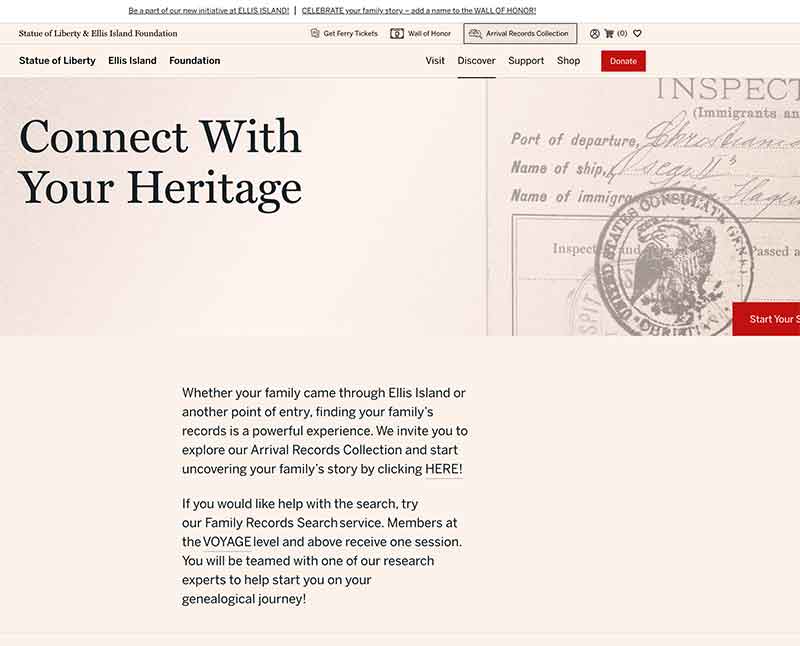
Modern genealogists benefit enormously from digitization projects that have made Ellis Island records accessible online. The Statue of Liberty-Ellis Island Foundation maintains one of the best-known searchable databases containing millions of passenger arrival records. Researchers can search by surname, ship name, date of arrival, nationality, or town of origin. Many records include scanned copies of original manifests showing handwritten information recorded when immigrants arrived.
Passenger manifests are especially valuable for genealogy because they often contain details unavailable elsewhere. Early manifests may list the immigrant’s last place of residence, nearest relative in the old country, destination in America, occupation, and physical description. Later manifests became even more detailed, asking questions about literacy, finances, prior visits to the United States, and final destinations. These records help genealogists connect American ancestors to specific towns and regions in Europe or elsewhere.
One challenge in Ellis Island research involves name variations and spelling differences. Immigration officials sometimes recorded names phonetically or with spelling changes based on language barriers and accents. Handwriting interpretation can also create confusion when reviewing scanned documents. Successful genealogists often search multiple spelling variations and remain flexible when interpreting records. Family names may have changed significantly after immigration as families adapted to American society.
The Ellis Island database is not the only important resource available to genealogists. Researchers often combine Ellis Island records with census records, naturalization documents, military records, city directories, church records, and vital records such as birth, marriage, and death certificates. Together, these sources help build more complete family histories and migration stories.
Visiting Ellis Island in person can also be meaningful for genealogy enthusiasts. Many descendants of immigrants describe emotional experiences standing in the same Registry Room their ancestors passed through generations earlier. Museum exhibits display photographs, artifacts, oral histories, and recreated inspection areas that help visitors understand what immigrant ancestors experienced upon arrival. Interactive displays and research areas allow visitors to explore family records while touring the site.
The American Immigrant Wall of Honor at Ellis Island provides another genealogical connection for families. The wall contains hundreds of thousands of names honoring immigrants who entered the United States. Families can search the wall’s database and even add ancestors’ names through donation programs supporting preservation efforts. For many descendants, seeing an ancestor’s name displayed publicly creates a strong emotional connection to family heritage and immigration history.
Ellis Island research has become especially popular as genealogy itself has grown dramatically in popularity during recent decades. Television programs, DNA testing services, online family trees, and historical databases have encouraged millions of people to explore their ancestry. Ellis Island records are often among the first major discoveries made by Americans tracing immigrant ancestors from Europe and other regions.
Technology has transformed genealogical research compared to earlier generations. In the past, researchers often had to travel to archives or request records manually through mail correspondence. Today, digital databases allow researchers to search millions of records from home within seconds. High-resolution scans of original manifests make it possible to examine historical handwriting and annotations in detail. Some databases even use artificial intelligence and advanced indexing systems to improve search accuracy.
Despite the convenience of online research, genealogy still requires patience and critical thinking. Researchers frequently encounter incomplete records, conflicting information, or missing documents. Immigration dates may vary between records, names may change over time, and some family stories may prove inaccurate. Successful genealogists learn to cross-reference multiple sources and carefully evaluate evidence before drawing conclusions.
Ellis Island also serves as a broader symbol of immigration and cultural identity in the United States. The stories preserved there reflect themes of sacrifice, hope, hardship, and opportunity that shaped countless American families. Many descendants feel a deep personal connection to the island because it represents the beginning of their family’s American journey. School groups, historians, and tourists visit Ellis Island not only to study immigration history but also to better understand the diverse origins of the American population.
The museum today emphasizes that immigration history is not simply about statistics and documents but about individuals and families. Exhibits often focus on personal stories of immigrants who arrived with few possessions but contributed greatly to American society through labor, entrepreneurship, military service, education, science, art, and culture. Ellis Island reminds visitors how immigration shaped the growth and identity of the United States itself.
Preservation efforts continue to maintain Ellis Island as both a historical site and research resource. Conservation work protects original structures and documents while educational programs introduce new generations to immigration history. The combination of historical exhibits and accessible genealogical databases ensures that Ellis Island remains highly relevant today.
Ultimately, Ellis Island occupies a unique place in American history because it combines national history with deeply personal family stories. For millions of Americans, genealogy research at Ellis Island provides more than names and dates—it offers a connection to ancestors whose courage and determination shaped future generations. Whether accessed online through searchable databases or experienced in person through museum visits and historical tours, Ellis Island continues helping people discover, preserve, and understand their family histories more than a century after the great waves of immigration first passed through its doors.